No products in the cart.


Fortrans is an osmotic laxative for bowel cleansing before endoscopy, X-ray exams or surgery, ensuring complete intestinal evacuation.

🇦🇺 Australia
🇨🇦 Canada
🇨🇿 Czechia
🇩🇰 Denmark
🇪🇪 Estonia
🇮🇪 Ireland
🇮🇱 Israel
🇮🇹 Italy
🇯🇵 Japan
🇱🇹 Lithuania🇲🇽 Mexico
🇳🇱 Netherlands🇵🇱 Poland
🇸🇰 Slovakia
🇰🇷 South Korea
🇨🇭 Switzerland
🇬🇧 United Kingdom
🇺🇸 United States of America
and more
🇦🇺 Australia
🇨🇦 Canada
🇨🇿 Czechia
🇩🇰 Denmark
🇪🇪 Estonia
🇮🇪 Ireland
🇮🇱 Israel
🇮🇹 Italy
🇯🇵 Japan
🇱🇹 Lithuania🇲🇽 Mexico
🇳🇱 Netherlands🇵🇱 Poland
🇸🇰 Slovakia
🇰🇷 South Korea
🇨🇭 Switzerland
🇬🇧 United Kingdom
🇺🇸 United States of America
and more

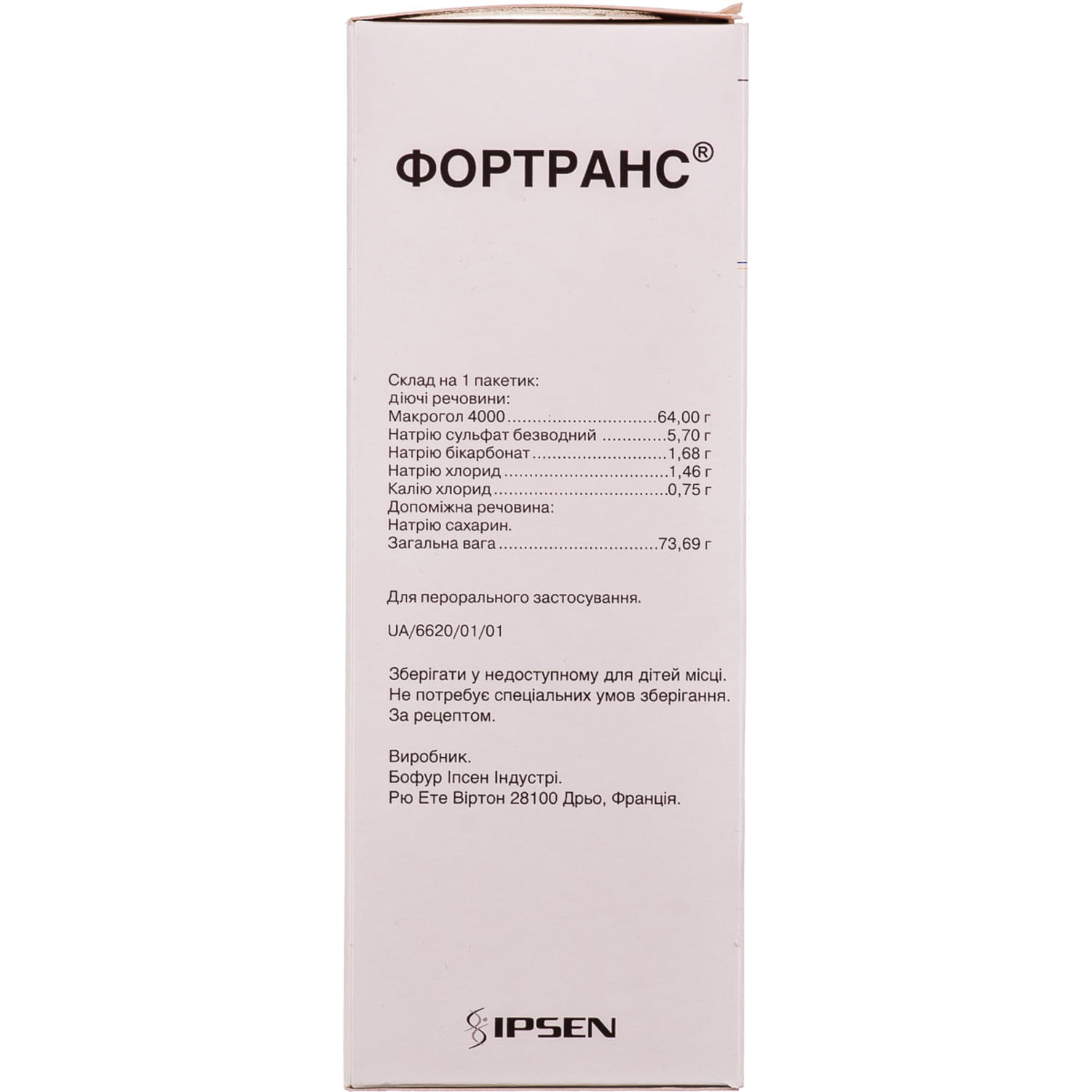


Please note: The product packaging may vary from the images shown. The contents, ingredients, and quality of the product remain unchanged.
$31.85
to: Australia, Canada, Czechia, Denmark, Estonia, Ireland, Israel, Italy, Japan, Lithuania, Mexico, Netherlands, Poland, Slovakia, South Korea, Switzerland, United Kingdom, United States and more
In stock
Fortrans is an osmotic laxative for bowel cleansing before endoscopy, X-ray exams or surgery, ensuring complete intestinal evacuation.
PayPal, Debit or Credit card, Google Pay, Apple Pay
Pharmacodynamics. Due to the formation of hydrogen bonds with water molecules, Fortrans retains it in the intestine. Water fills and increases the contents of the intestine along its entire length. After that, the drug is completely evacuated from the intestine along with its contents.
The volume of unabsorbed fluid in the intestine is responsible for the laxative effect of the drug solution.
Pharmacokinetics. The drug is not absorbed or metabolized. It is excreted from the body unchanged.
Colon cleansing to prepare patients for endoscopic and X-ray examinations, and intestinal surgery.
Fortrans is used only in adult patients. For oral administration.
Dissolve the contents of each sachet in 1 liter of water until the powder is completely dissolved.
The dose is set at the rate of approximately 1 liter of solution per 15-20 kg of body weight. The dose is 3-4 liters of solution depending on the patient’s body weight.
The drug can be administered in 1 or 2 stages, provided that the reconstituted solution is taken in full (on average 3-4 liters of solution depending on the patient’s body weight).
training scheme
One-step preparation: 3-4 liters the evening before the procedure, a break of 1 hour is possible after the first 2 liters.
Two-step preparation: 2 liters in the evening before the procedure and 1-2 liters in the morning on the day of the procedure, the last glass should be taken 3-4 hours before the procedure, or 3 liters in the evening before the procedure and 1 liter in the morning on the day of the procedure, the last glass should be taken 3-4 hours before the procedure.
The recommended rate of use of the drug is 1-1.5 l / h (250 ml every 10-15 min).
The doctor can individually determine the recommended dosage of the drug according to the patient’s clinical condition and potential concomitant diseases.
Patients with renal impairment: There are insufficient data in this category of patients (see Precautions).
Children. The safety and effectiveness of Fortrans in children (under 18 years of age) have not been established.
Hypersensitivity to the active substances or excipients of the drug; severe disorders of the patient’s general condition, for example, dehydration or severe heart failure; advanced carcinoma or any other disease of the large intestine, accompanied by widespread damage to the intestinal mucosa; the presence or risk of intestinal obstruction or gastrointestinal obstruction; perforation or threat of perforation of the gastrointestinal tract; abdominal pain of undetermined origin; impaired gastric emptying (e.g. gastroparesis); toxic colitis or toxic megacolon.
Diarrhea is an expected consequence of using the drug Fortrans.
At the beginning of the treatment, attacks of nausea and vomiting were noted, which usually disappeared with further use.
The following are adverse reactions from clinical trials and adverse events reported during post-marketing experience. The frequency is defined as follows: very common (≥1/10), common (≥1/100 to 1/10), uncommon (≥1/1000 to 1/100), rare (≥1/10,000 to 1/1000), very rare (<1/10,000), not known (cannot be estimated from the available data).
From the digestive system: very often – nausea, abdominal pain, bloating; often – vomiting.
Immune system disorders: not known – hypersensitivity reactions, including anaphylactic shock, angioedema, urticaria, rash, itching.
Elderly people with weakened health are recommended to use the drug only under the supervision of a doctor.
Diarrhea caused by the use of the drug Fortrans may impair the absorption of drugs taken simultaneously with this drug (see Interactions with other drugs).
This medicine contains polyethylene glycol (PEG).
Allergic reactions reported with the use of macrogol-based medicines: anaphylactic shock, rash, urticaria, angioedema (see Side effects).
The drug should not cause electrolyte imbalance, given its isotonic composition; however, exceptional cases of water and electrolyte disturbances have been reported in patients at risk. Patients with signs of dehydration or electrolyte disturbances should have them corrected before using the drug for bowel cleansing. This drug should be used with caution in patients with such disturbances, as well as in patients taking concomitant medications that increase the risk of water and electrolyte disturbances, including hyponatremia and hypokalemia, or the risk of potential complications (e.g. patients with impaired renal function, heart failure or concomitant treatment with diuretics). In this case, patients require appropriate monitoring.
Patients prone to aspiration, bedridden, or with neurological and/or motor impairments due to the risk of aspiration pneumonia should be administered with caution and only under medical supervision. Such patients should be administered in a sitting position and via a nasogastric tube.
Patients with heart or kidney failure may develop acute pulmonary edema due to excessive water intake.
This medicinal product contains sodium. The medicinal product contains 1.967 g of sodium per sachet. This should be taken into consideration by patients on a controlled salt diet.
Pregnancy: There are no or limited amount of data from the use of Fortrans in pregnant women. Preclinical data on reproductive toxicity are insufficient.
Fortrans can be used only after careful assessment of the risk to the fetus and the benefit to the mother.
Breastfeeding. There are no or limited data on the use of Fortrans during breast-feeding. It is not known whether macrogol 4000 is excreted in breast milk. A risk to newborns/infants cannot be excluded.
Fortrans can be used only after careful assessment of the risk to the fetus and the benefit to the mother.
Fertility: There are no data on the effect of Fortrans on fertility.
If a woman is pregnant or breastfeeding, or suspects or plans to become pregnant, she should consult a doctor before using Fortrans.
Do not use in children.
Studies on the effects on the ability to drive and use machines have not been conducted.
The prescribing healthcare professional should be informed of any other medicinal products that the patient is taking orally at the same time. Due to the gastric emptying caused by Fortrans, other medicinal products for oral use may not be absorbed and should therefore be taken at least 2 hours before the solution. It is necessary to avoid taking medicinal products for oral use before and after taking a laxative until the medical examination is complete. For medicinal products with a narrow therapeutic range or short t½, a particular effect on efficacy is possible.
No reports of overdose have been received.
However, the patient’s fluid and salt balance and hydration status should be monitored in case of overdose with severe diarrhea.
Does not require special storage conditions. Keep out of the reach of children.


UApothecary combines medicine search, online ordering, and pharmaceutical consultations. We provide up-to-date information about medications, updating data several times a day. We collaborate with doctors, pharmacists, and medical organizations to offer professional support. We guarantee the quality of medicines and convenient worldwide delivery. Our mission is to make quality medicines accessible to everyone.
This site is protected by reCAPTCHA and the Google
Privacy Policy and
Terms of Service apply.