No products in the cart.
Nifuroxazide treats infectious diarrhea with local antibacterial action in the intestine, without systemic absorption, effective from first hours of use.

🇦🇺 Australia
🇨🇦 Canada
🇨🇿 Czechia
🇩🇰 Denmark
🇪🇪 Estonia
🇮🇪 Ireland
🇮🇱 Israel
🇮🇹 Italy
🇯🇵 Japan
🇱🇹 Lithuania🇲🇽 Mexico
🇳🇱 Netherlands🇵🇱 Poland
🇸🇰 Slovakia
🇰🇷 South Korea
🇨🇭 Switzerland
🇬🇧 United Kingdom
🇺🇸 United States of America
and more
🇦🇺 Australia
🇨🇦 Canada
🇨🇿 Czechia
🇩🇰 Denmark
🇪🇪 Estonia
🇮🇪 Ireland
🇮🇱 Israel
🇮🇹 Italy
🇯🇵 Japan
🇱🇹 Lithuania🇲🇽 Mexico
🇳🇱 Netherlands🇵🇱 Poland
🇸🇰 Slovakia
🇰🇷 South Korea
🇨🇭 Switzerland
🇬🇧 United Kingdom
🇺🇸 United States of America
and more
$19.19 Original price was: $19.19.$17.39Current price is: $17.39.
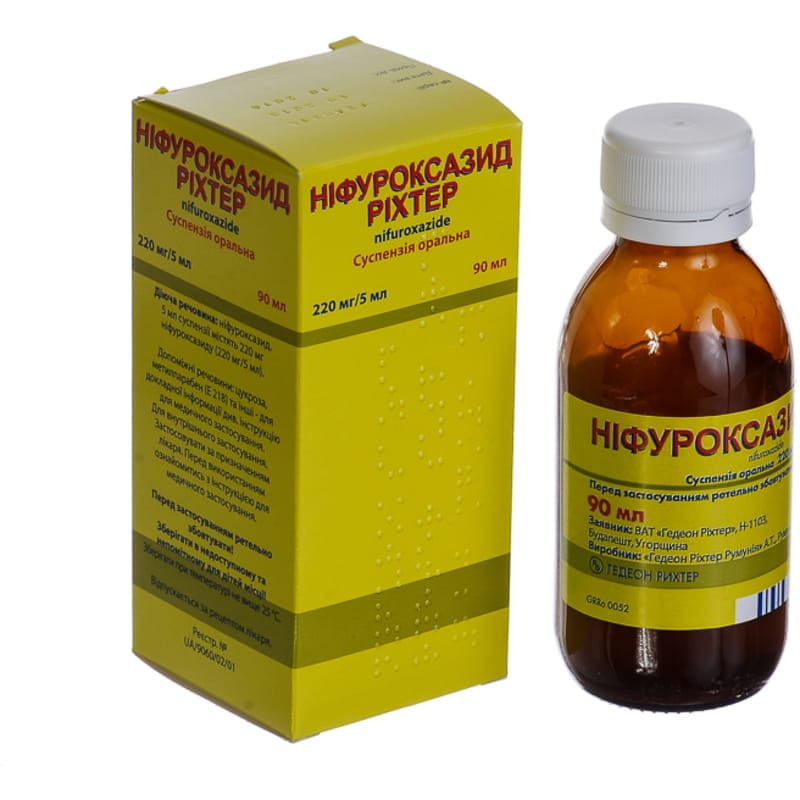
Please note: The product packaging may vary from the images shown. The contents, ingredients, and quality of the product remain unchanged.
$25.31
to: Australia, Canada, Czechia, Denmark, Estonia, Ireland, Israel, Italy, Japan, Lithuania, Mexico, Netherlands, Poland, Slovakia, South Korea, Switzerland, United Kingdom, United States and more
In stock
Nifuroxazide treats infectious diarrhea with local antibacterial action in the intestine, without systemic absorption, effective from first hours of use.
PayPal, Debit or Credit card, Google Pay, Apple Pay
Pharmacodynamics. Nifuroxazide is an antimicrobial drug, a derivative of nitrofuran. The mechanism of action is not fully understood. It is assumed that nifuroxazide inhibits the activity of dehydrogenases and disrupts protein synthesis in pathogenic bacteria. The antimicrobial and antiparasitic properties of nifuroxazide are possibly due to the presence of an amino group. Local activity and lack of penetration into the organs and tissues of the body determine the uniqueness of nifuroxazide in comparison with other nitrofuran derivatives, since there is no systemic effect of this antidiarrheal drug.
Nifuroxazide is effective against most pathogens of intestinal infections (including mutant strains resistant to other antimicrobial agents). It exhibits local antibacterial action in the intestinal lumen against some species of gram-positive bacteria of the Staphylococcus family and some species of gram-negative bacteria of the Enterobacteriaceae family of species: Yersinia sp., Escherichia sp., Citobacter sp., Enterobacter sp., Klebsiella sp., Salmonella sp.
In medium therapeutic doses it has a bacteriostatic effect, and in higher doses it has a bactericidal effect. In therapeutic doses it does not disturb the balance of saprophytic bacterial flora of the large intestine, does not cause the development of resistant strains of pathogenic microorganisms and cross-resistance of bacteria to other antimicrobial agents, which allows, if necessary, to prescribe it in complex therapy with systemic antibacterial drugs for generalized infections. In intestinal infections of viral origin it prevents the development of bacterial superinfection. The effectiveness of the drug does not depend on the pH in the intestinal lumen. The therapeutic effect is achieved from the first hours of treatment.
Pharmacokinetics. After ingestion, it is practically not absorbed in the gastrointestinal tract and does not enter the organs and tissues, creating a high concentration of the active substance in the intestine (99% of the drug taken remains in the intestine). Nifuroxazide is metabolized in the intestine, more than 20% is excreted unchanged. Nifuroxazide and its metabolites are excreted in the feces. The rate of excretion depends on the amount of the drug taken and on the motility of the gastrointestinal tract. In general, the excretion of nifuroxazide is slow, it remains in the gastrointestinal tract for a long time.
Acute diarrhea of infectious origin.
Tablets. Tablets should be taken orally whole, washed down with sufficient water, regardless of meals. The maximum daily dose is 800 mg.
Adults and children over 15 years of age: 200 mg (2 tablets of 100 mg) 4 times a day.
Children over 6 years of age: 200 mg (2 tablets of 100 mg) 3-4 times a day.
Duration of treatment – no more than 7 days. If symptoms persist, consult a doctor.
Suspension. The drug is taken orally, regardless of meals. Before use, the bottle with the suspension must be shaken thoroughly. The maximum daily dose of nifuroxazide is 800 mg.
Children over 2 years of age: 5 ml of suspension 3 times a day.
Adults: 5 ml of suspension 4 times a day.
The duration of treatment is no more than 7 days.
Hypersensitivity to nifuroxazide and other nitrofuran derivatives or any of the excipients.
Blood and lymphatic system disorders: One case of granulocytopenia has been described.
On the part of the immune system: allergic reactions, including angioedema (Quincke’s edema), anaphylactic shock, urticaria and itching of the skin. The occurrence of an allergic reaction requires discontinuation of the drug. In the future, the patient should avoid the use of nifuroxazide and other nitrofuran derivatives.
On the part of the digestive system: individual cases of hypersensitivity to nifuroxazide are manifested by transient abdominal pain, nausea, vomiting and exacerbation of diarrhea. In the event of the appearance of such symptoms of minor intensity, there is no need to use special therapy or discontinue the use of nifuroxazide, since the symptoms disappear quickly. If the exacerbation is severe, nifuroxazide should be discontinued. In the future, the patient should not take nifuroxazide and other nitrofuran derivatives.
Skin and subcutaneous tissue disorders: Rarely, reactions such as skin rash and itching have been reported. One case of pustulosis in an elderly person and one case of nodular urticaria in the presence of contact allergy to nifuroxazide have been reported.
During treatment with Nifuroxazide, it is strictly forbidden to drink alcohol (see Interactions).
Treatment with Nifuroxazide does not exclude dietary regimen and rehydration. If diarrhea does not stop after 3 days from the start of treatment, we require enhanced diagnostics to determine the cause of the symptoms. Antibiotic therapy may be necessary. If necessary, concomitant rehydration therapy is used depending on the age and condition of the patient and the intensity of diarrhea.
If oral or intravenous rehydration is prescribed, the instructions for dilution and use of the solutions intended for this purpose should be followed. If such rehydration is not necessary, fluid loss should be compensated by drinking plenty of drinks containing salt and sugar (based on an average daily requirement of 2 liters of water).
Dietary recommendations during diarrhea should be considered: avoid fresh vegetables and fruits, spicy foods, frozen foods and drinks. Rice should be preferred. The decision on the use of dairy products is made individually.
If diarrhea is accompanied by clinical manifestations indicating progression of the condition (worsening of the general condition, fever, symptoms of intoxication), Nifuroxazide Richter should be prescribed together with antibacterial drugs used to treat intestinal infections, since the drug is not absorbed in the intestine and does not enter the systemic bloodstream. The drug should not be prescribed as monotherapy for the treatment of intestinal infections complicated by septicemia.
If a hypersensitivity reaction occurs (shortness of breath, swelling of the face, lips, tongue, skin rashes, itching), nifuroxazide should be discontinued immediately.
Nifuroxazide Richter, oral suspension, contains sucrose, which should be taken into account when using it in patients with diabetes mellitus. It is not recommended to prescribe the drug to patients with hereditary disorders of tolerance to sucrose, fructose. The drug contains methyl parahydroxybenzoate (E218), which may cause a delayed allergic reaction.
Use during pregnancy and breastfeeding. There is insufficient data on possible teratogenic and fetotoxic effects of using nifuroxazide during pregnancy. Therefore, as a precautionary measure, the drug is not recommended during this period.
Nifuroxazide Richter can be used in women during breastfeeding, provided that the treatment is short-term.
Children. Nifuroxazide Richter in the form of 100 mg tablets can be prescribed to children over the age of 6 years. Children under the age of 6 years are recommended to take the drug Nifuroxazide Richter in the form of a suspension. The drug is not prescribed to children under the age of 2 years.
Ability to influence the reaction rate when driving vehicles or other mechanisms. Nifuroxazide does not affect the reaction rate when driving vehicles or other mechanisms.
Simultaneous (at the same time) administration of other oral medications should be avoided due to the strong adsorption properties of nifuroxazide.
Nifuroxazide is not recommended for use simultaneously with sorbents, drugs containing alcohol, drugs that can cause antabuse reactions, and drugs that depress the central nervous system.
During treatment with Nifuroxazide, alcohol consumption is strictly prohibited due to the possibility of developing a disulfiram-like reaction, which is manifested by exacerbation of diarrhea, vomiting, abdominal pain, a feeling of heat in the face and upper body, hyperemia, tinnitus, difficulty breathing, tachycardia.
One case of overdose has been described, accompanied by short-term symptoms of diarrhea and drowsiness. In case of overdose, gastric lavage and symptomatic treatment are recommended.
Tablets do not require special storage conditions; suspension – at a temperature not exceeding 25 °C.

UApothecary combines medicine search, online ordering, and pharmaceutical consultations. We provide up-to-date information about medications, updating data several times a day. We collaborate with doctors, pharmacists, and medical organizations to offer professional support. We guarantee the quality of medicines and convenient worldwide delivery. Our mission is to make quality medicines accessible to everyone.
This site is protected by reCAPTCHA and the Google
Privacy Policy and
Terms of Service apply.
Reviews
There are no reviews yet.