No products in the cart.

We deliver to:
🇦🇺 Australia
🇨🇦 Canada
🇨🇿 Czechia
🇩🇰 Denmark
🇪🇪 Estonia
🇮🇪 Ireland
🇮🇱 Israel
🇮🇹 Italy
🇯🇵 Japan
🇱🇹 Lithuania🇲🇽 Mexico
🇳🇱 Netherlands🇵🇱 Poland
🇸🇰 Slovakia
🇰🇷 South Korea
🇨🇭 Switzerland
🇬🇧 United Kingdom
🇺🇸 United States of America
and more
We deliver to:
🇦🇺 Australia
🇨🇦 Canada
🇨🇿 Czechia
🇩🇰 Denmark
🇪🇪 Estonia
🇮🇪 Ireland
🇮🇱 Israel
🇮🇹 Italy
🇯🇵 Japan
🇱🇹 Lithuania🇲🇽 Mexico
🇳🇱 Netherlands🇵🇱 Poland
🇸🇰 Slovakia
🇰🇷 South Korea
🇨🇭 Switzerland
🇬🇧 United Kingdom
🇺🇸 United States of America
and more

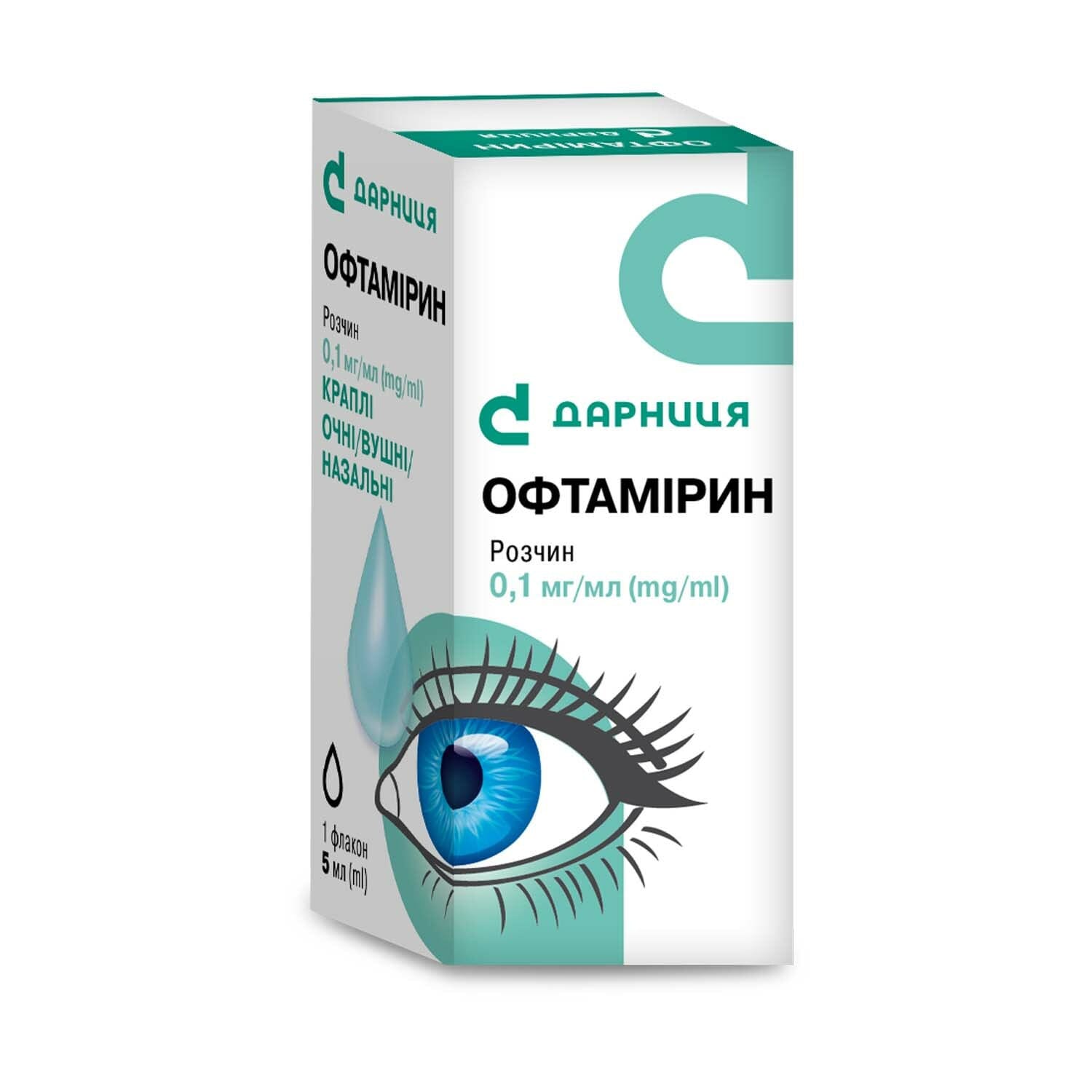
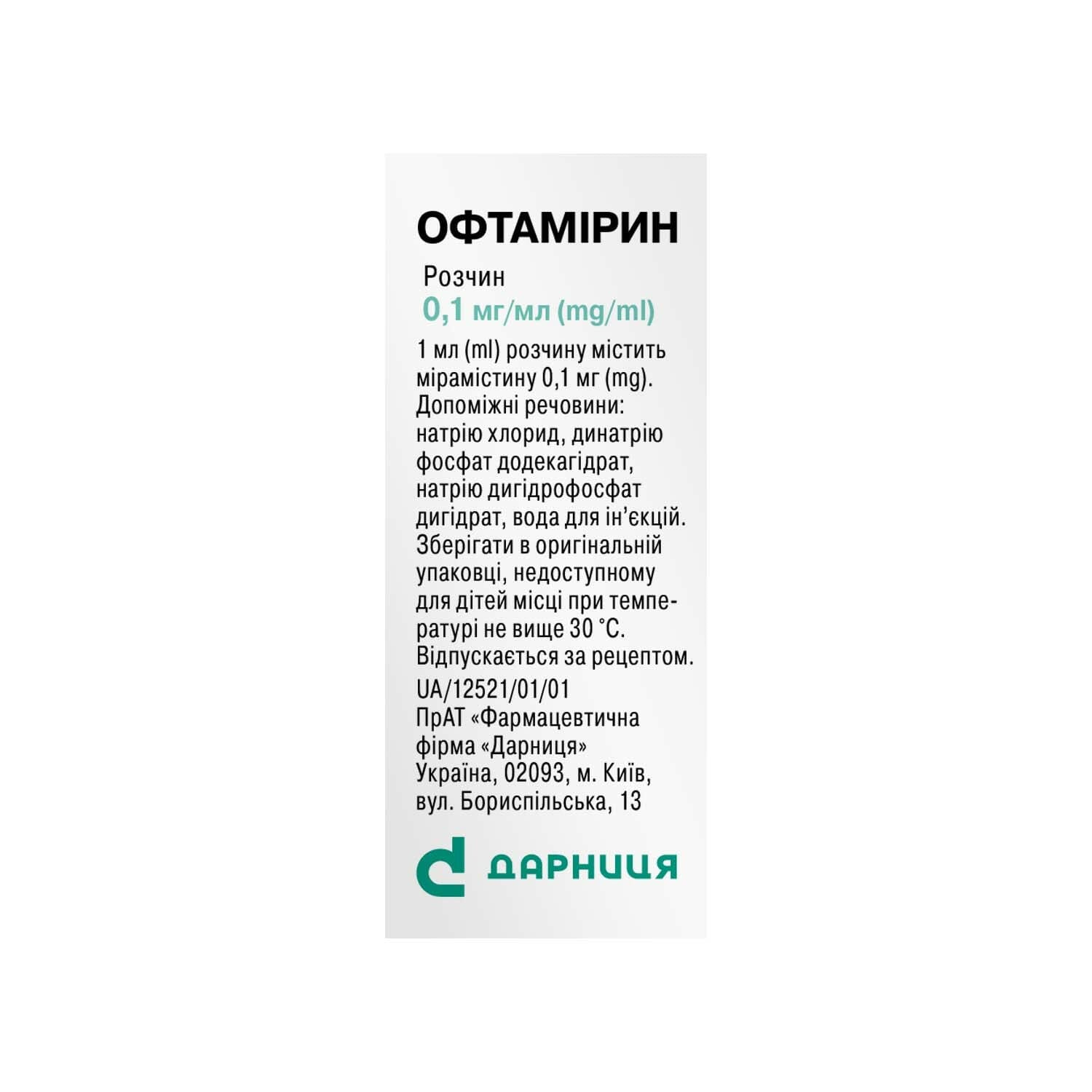
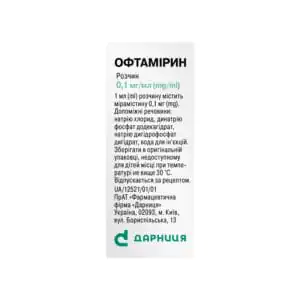
Please note: The product packaging may vary from the images shown. The contents, ingredients, and quality of the product remain unchanged.
Oftamirin eye/ear/nasal drops solution 0.1 mg/ml bottle 5 ml
$14.98
Free Worldwide Shipping
to: Australia, Canada, Czechia, Denmark, Estonia, Ireland, Israel, Italy, Japan, Lithuania, Mexico, Netherlands, Poland, Slovakia, South Korea, Switzerland, United Kingdom, United States and more
In stock
Oftamirin 0.1 mg/ml eye, ear and nasal drops (5 ml) with miramistin provide antimicrobial action for eye and ENT infections, injuries and prevention.
Categories: Eye and ear
Brand: Darnytsia
Payment
PayPal, Debit or Credit card, Google Pay, Apple Pay
Pharmacological properties
Pharmacodynamics. Miramistin is a cationic surfactant with antimicrobial (antiseptic) action.
The action of Miramistin is based on the direct hydrophobic interaction of the molecule with the lipids of the membranes of microorganisms, which leads to their fragmentation and destruction. At the same time, part of the Miramistin molecule, immersing in the hydrophobic area of the membrane, destroys the supramembrane layer, loosens the membrane, increases its permeability for high-molecular substances, changes the enzymatic activity of the microbial cell, inhibits enzyme systems, which leads to the suppression of the vital activity of microorganisms and their cytolysis.
Unlike other antiseptics, Miramistin has a high selectivity of action against microorganisms, because it practically does not act on the membranes of human cells. This effect is associated with a different structure of human cell membranes (a significantly longer length of lipid radicals, which sharply limits the possibility of hydrophobic interaction of Miramistin with cells).
Miramistin has a pronounced antimicrobial effect against gram-positive and gram-negative, aerobic and anaerobic, spore-forming and asporogenic bacteria in the form of monocultures and microbial associations, including hospital strains with multidrug resistance to antibiotics.
It has a bactericidal effect on pathogens of sexually transmitted diseases – gonococci, pale treponema, trichomonads, chlamydia, as well as herpes viruses, human immunodeficiency virus, etc. It has an antifungal effect on ascomycetes of the genus Aspergillus and the genus Penicillum, yeast (Rhodotorula rubra, Torulopsis gabrata, etc.) and yeast-like (Candida albicans, Candida krusei, etc.) fungi, dermatophytes (Trichophyton rubrum, Trichophyton mentagrophytes, Trichopphyton verrucosum, T. schoenleini, T. violaceum, Epidermophyton Kaufman-Wolf, E. floccosum, Microsporum gypseum, Microsporum canis, etc.), as well as on other pathogenic fungi (for example, Pityrosporum orbiculare (Malassezia furfur)) in the form of monocultures and microbial associations, including fungal microflora with resistance to chemotherapeutic drugs. Under the action of Miramistin, the resistance of microorganisms to antibiotics decreases.
Miramistin has anti-inflammatory and immunoadjuvant effects, enhances local protective reactions, regenerative processes, activates nonspecific defense mechanisms due to modulation of cellular and local humoral immune responses, which accelerates recovery.
Pharmacokinetics. Miramistin has a local effect. There is no data on the possibility of the drug penetrating into the systemic bloodstream.
Indication
In the complex treatment of infectious processes of the anterior segment of the eye (blepharitis, conjunctivitis, keratitis, keratouveitis) caused by gram-positive and gram-negative bacteria, chlamydia, fungi and viruses sensitive to Miramistin, eye injuries, eye burns (thermal and chemical).
Prevention of ophthalmia in newborns, including gonococcal and chlamydial ophthalmia.
Prevention and treatment of purulent-inflammatory lesions of the eye in the pre- and postoperative period.
In the complex treatment of acute and chronic otitis externa, chronic purulent mesotympanitis, otomycosis.
In the complex treatment of acute rhinitis.
Application
Ophthalmology
For the treatment of infectious processes of the anterior segment of the eye, adults and children over 12 years of age are instilled into the conjunctival sac 2-3 drops, children under 12 years of age – 1-2 drops 4-6 times a day. The duration of treatment usually does not exceed 2 weeks.
To prevent complications in the pre- and postoperative period – 2-3 drops 3 times a day for 2-3 days before the operation. After the operation – 1-2 drops 3 times a day for 3-5 days.
When treating eye burns, after rinsing the eye with plenty of water, frequent instillations (every 5-10 minutes) are performed for 1-2 hours. For further treatment, the drug is used in adults and children over 12 years of age – 2-3 drops, children under 12 years of age – 1-2 drops 4-6 times a day.
To prevent ophthalmia in newborns, immediately after birth, the child is instilled with 1 drop of the drug in each eye 3 times with an interval of 2-3 minutes.
Otolaryngology
In the treatment of acute and chronic external otitis, otomycosis:
- adults are instilled with 3-5 drops 4-6 times a day;
- children under 12 years old – 2-3 drops 4-6 times a day.
The duration of treatment is 10-14 days.
A gauze swab moistened with the drug can be inserted into the external auditory canal 4-6 times a day for 10-14 days (instead of instillation).
In chronic mesotympanitis, it is used in complex treatment using hardware ultrasonic irrigation or injection into the tympanic cavity in combination with antibiotics.
In the treatment of acute rhinitis, infections of the nasal mucosa, adults are instilled with 2-3 drops, children under 12 years of age – 1-2 drops in each nostril 4-6 times a day. The course of treatment is 7-14 days.
Dosage features. Accurate dosing is achieved by pressing the bottom of the bottle – 1 press = 1 drop.
Contraindication
Increased individual sensitivity to Miramistin or other components of the drug.
Side effects
When using the drug, a short-term burning sensation may occur, which disappears on its own after 15-20 seconds. Treatment discontinuation is not required.
Special instructions
Use during pregnancy or breastfeeding. The drug can be used during pregnancy or breastfeeding.
Children. The drug is used in pediatric practice.
The ability to influence the reaction speed when driving vehicles or working with other mechanisms. Does not affect.
Interactions
When used simultaneously with systemic and local antibiotics, the effectiveness of the drug increases.
Overdose
Cases of overdose have not been established.
Storage conditions
In the original packaging at a temperature not exceeding 30 °C. Keep the bottle tightly closed between uses. After opening the bottle, the drug should be used for no more than 28 days.
Be the first to review “Oftamirin eye/ear/nasal drops solution 0.1 mg/ml bottle 5 ml” Cancel reply
You may also like

Reviews
There are no reviews yet.