


Dvatse Long 600 mg acetylcysteine granules help loosen mucus, support easier breathing, and relieve cough in bronchopulmonary conditions for chest health.

We deliver to:
🇦🇺 Australia
🇧🇪 Belgium
🇨🇦 Canada
🇨🇿 Czechia
🇩🇰 Denmark
🇪🇪 Estonia
🇫🇮 Finland
🇬🇷 Greece
🇭🇺 Hungary
🇮🇪 Ireland
🇮🇱 Israel
🇮🇹 Italy
🇯🇵 Japan
🇰🇼 Kuwait
🇱🇻 Latvia
🇱🇹 Lithuania
🇲🇽 Mexico
🇲🇩 Moldova
🇳🇱 Netherlands
🇳🇴 Norway
🇵🇱 Poland
🇷🇴 Romania
🇸🇰 Slovakia
🇰🇷 South Korea
🇨🇭 Switzerland
🇬🇧 United Kingdom
🇺🇸 United States of America
and more
We deliver to:
🇦🇺 Australia
🇧🇪 Belgium
🇨🇦 Canada
🇨🇿 Czechia
🇩🇰 Denmark
🇪🇪 Estonia
🇫🇮 Finland
🇬🇷 Greece
🇭🇺 Hungary
🇮🇪 Ireland
🇮🇱 Israel
🇮🇹 Italy
🇯🇵 Japan
🇰🇼 Kuwait
🇱🇻 Latvia
🇱🇹 Lithuania
🇲🇽 Mexico
🇲🇩 Moldova
🇳🇱 Netherlands
🇳🇴 Norway
🇵🇱 Poland
🇷🇴 Romania
🇸🇰 Slovakia
🇰🇷 South Korea
🇨🇭 Switzerland
🇬🇧 United Kingdom
🇺🇸 United States of America
and more
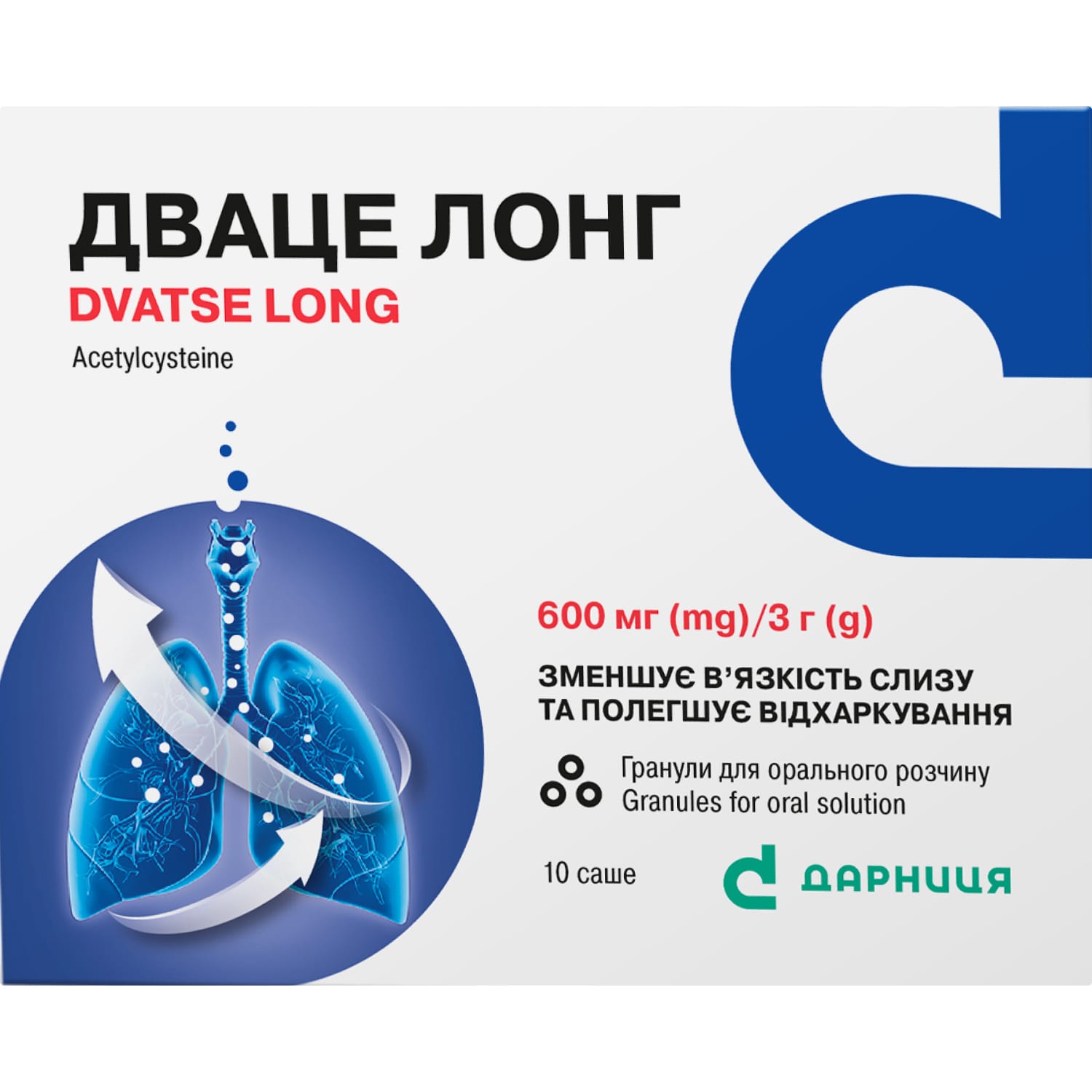
Please note: The product packaging may vary from the images shown. The contents, ingredients, and quality of the product remain unchanged.
Dvatse Long granules for oral solution 600 mg sachet 3 g pack of 10 pcs.
$22.29
Free Worldwide Shipping
to: Australia, Belgium, Canada, Czechia, Denmark, Estonia, Finland, Greece, Hungary, Ireland, Israel, Italy, Japan, Kuwait, Latvia, Lithuania, Mexico, Moldova, Netherlands, Norway, Poland, Romania, Slovakia, South Korea, Switzerland, United Kingdom, United States and more
🏖️ Hello! We are on vacation!
We are still accepting orders on our website; however, order processing and shipping will resume after September 10. If you place an order during our vacation, we will contact you and remind you about the temporary shipping delay. Starting September 10, all orders received during this period will be processed and shipped in the order they were placed. If your order contains a product with less than one year remaining before its expiration date, we will notify you after September 10 and proceed according to your instructions. If you decide to cancel an order placed during our vacation, simply contact us through the contact form on our website, and we will be happy to assist you. Thank you for your understanding, and we apologize for any inconvenience caused.
In stock
Categories: Cold and flu
Brand: Darnytsia
Payment
PayPal, Debit or Credit card, Google Pay, Apple Pay
Orders Temporarily Unavailable
Due to temporary postal service disruptions, we are currently unable to accept orders.
Dvatse Long is a remedy for the treatment of acute and chronic diseases of the bronchopulmonary system, accompanied by increased sputum production.
Composition
- active ingredient: acetylcysteine;
- 1 sachet contains 600 mg of acetylcysteine;
- excipients: sorbitol (E 420), acesulfame potassium, orange flavoring.
Contraindication
Known hypersensitivity to acetylcysteine or to any of the excipients of the drug. Gastric and duodenal ulcer in the acute stage, hemoptysis, pulmonary hemorrhage, severe exacerbation of bronchial asthma.
Adverse reactions
From the side of the organs of hearing and vestibular apparatus: infrequently – tinnitus.
Respiratory, thoracic and mediastinal disorders: rarely – dyspnoea, bronchospasm (mainly in patients with bronchial hyperreactivity associated with bronchial asthma); frequency unknown – rhinorrhea.
Gastrointestinal: infrequently – heartburn, stomatitis, abdominal pain, nausea, vomiting, diarrhea; rarely – dyspepsia; frequency unknown – bad breath.
From the nervous system: infrequently – headache.
From the cardiovascular system: infrequently – tachycardia, arterial hypotension; very rarely – hemorrhages.
Blood and lymphatic system disorders: frequency unknown – anemia.
On the part of the immune system: infrequently – hypersensitivity; very rarely – anaphylactic shock, anaphylactic/anaphylactoid reactions.
Skin and subcutaneous tissue disorders: infrequently – itching, urticaria, exanthema, rashes, angioedema (Quincke’s edema); frequency unknown – eczema.
General disorders: infrequently – hyperthermia; frequency unknown – facial edema.
In very rare cases, severe skin reactions (e.g. Stevens-Johnson syndrome and Lyell’s syndrome) have been reported in association with the use of acetylcysteine.
Method of application
Adults and children over 12 years of age – prescribe 600 mg once a day.
It is recommended to take the medicine after meals.
Dissolve the granules in a glass of water and drink the solution without delay, immediately after preparation.
When dissolving acetylcysteine, it is necessary to use glassware and avoid contact with metal and rubber surfaces.
Additional fluid intake enhances the mucolytic effect of the drug.
The duration of the course of treatment is determined by the doctor individually, depending on the nature of the disease. In acute uncomplicated diseases, acetylcysteine is used for 4–5 days.
Application features
Use during pregnancy or breastfeeding
The drug should be used during pregnancy or breastfeeding only after careful assessment of the benefit/risk ratio.
Children
Use in children over 12 years of age.
Ability to influence reaction speed when driving vehicles or other mechanisms
There is no evidence that acetylcysteine affects the ability to drive and use other mechanisms.
Overdose
There are no data on cases of overdose with oral administration of acetylcysteine.
Acetylcysteine, when used at a dose of 500 mg/kg/day, does not cause overdose.
Symptoms.
Overdose may manifest as gastrointestinal symptoms such as nausea, vomiting and diarrhea. Children are at risk of hypersecretion.
Treatment.
There is no specific antidote for acetylcysteine poisoning; therapy is symptomatic.
Interaction with other medicinal products and other types of interactions
It is not recommended to dissolve acetylcysteine with other medications in the same glass.
Interaction studies were conducted only with adults.
The use of antitussives with acetylcysteine may increase sputum congestion due to suppression of the cough reflex.
Activated charcoal reduces the effectiveness of acetylcysteine.
When used simultaneously with antibiotics such as tetracyclines (except doxycycline), ampicillin, amphotericin B, cephalosporins, aminoglycosides, their interaction with the thiol group of acetylcysteine is possible, which leads to a decrease in the activity of both drugs. Therefore, the interval between the use of these drugs should be at least 2 hours. This does not apply to cefixime and loracarbef.
With simultaneous use of nitroglycerin and acetylcysteine, significant hypotension and dilation of the temporal artery have been observed. If it is necessary to use nitroglycerin and acetylcysteine simultaneously, patients should be monitored for hypotension, which may be severe, and the possibility of headache should be taken into account.
Storage conditions
Store in the original packaging at a temperature not exceeding 25 °C.
Keep out of reach of children.
Be the first to review “Dvatse Long granules for oral solution 600 mg sachet 3 g pack of 10 pcs.” Cancel reply
You may also like


Reviews
There are no reviews yet.